Table of Contents
What is a PCBU? Meaning, duties and examples
A plain-English guide to the most important term in Australian WHS law
If you run a business in Australia, work health and safety law almost certainly treats you as a PCBU. The term sits at the centre of the model WHS laws: it decides who holds the primary duty of care, who must consult workers, and who can be prosecuted when something goes wrong.
This guide explains what PCBU means, who is and isn't a PCBU, what the duties involve, and how the PCBU fits alongside officers and workers.
What does PCBU stand for?
PCBU stands for person conducting a business or undertaking. It is defined in section 5 of the model Work Health and Safety Act, which has been adopted in every Australian state and territory except Victoria, and by the Commonwealth. Victoria's Occupational Health and Safety Act 2004 uses different terms, such as “employer”, and places similar duties on them.
The model laws deliberately moved away from the old idea that safety duties belong only to an “employer”. Work today is organised through contractors, labour hire, franchises, partnerships and volunteers, so the law attaches the main duty to whoever conducts the work, whatever their legal structure.
“Person” is used in its legal sense. A PCBU can be an individual, a company, a partnership, an association or a government body.
What counts as a business or undertaking?
A business or undertaking can be conducted alone or with others, and whether or not it is run for profit or gain. In practice:
- A business is usually an activity carried on with a view to making a profit, such as a trade, a shop, a consultancy or a manufacturing company.
- An undertaking covers organised activities that aren't commercial, such as a charity, a sporting club with paid staff, a school or a government department.
Common examples of PCBUs include:
- companies, from small proprietary companies to large corporations
- sole traders, such as a self-employed electrician or consultant
- partnerships, where each partner is treated as conducting the business
- incorporated associations, charities and not-for-profits that engage workers
- government departments, agencies and local councils
- both businesses in a labour hire arrangement: the labour hire provider and the host
The PCBU is the entity running the business, not a building or a job title. If you want to see how this plays out for partnerships, sole traders and committees, read why ‘we’re not a company’ is not a WHS defence.
Who is not a PCBU?
The WHS Act carves out a few situations where a person is not a PCBU:
- Workers and officers are not PCBUs just because they work for, or make decisions in, a business. They have their own, separate duties (covered below).
- Elected members of local councils are not PCBUs when acting in that capacity. The council itself still is.
- Volunteer associations are not PCBUs. These are groups of volunteers working together for a community purpose that don't employ anyone. Once an association employs a single person, it becomes a PCBU.
The WHS Regulations also exclude some residential strata bodies corporate that don't employ anyone. If you are unsure whether an exclusion applies to you, check with your state regulator or get legal advice.
What are a PCBU's duties?
The primary duty of care
Section 19 of the WHS Act sets out the primary duty of care. A PCBU must ensure, so far as is reasonably practicable, the health and safety of:
- workers it engages, or causes to be engaged, including employees, contractors, subcontractors and labour hire workers
- workers whose activities it influences or directs
- other people, such as visitors, customers and members of the public, who could be put at risk by the work
In practice, that means providing and maintaining:
- a work environment without risks to health and safety, covering both physical and psychological health
- safe plant, structures and systems of work
- safe use, handling and storage of plant, structures and substances
- adequate facilities for workers' welfare, such as toilets, drinking water and first aid
- the information, training, instruction and supervision workers need to work safely
- monitoring of workers' health and workplace conditions, to prevent illness and injury
Other PCBU duties
On top of the primary duty, PCBUs must:
- consult, so far as is reasonably practicable, with workers who are, or are likely to be, directly affected by a WHS matter
- consult, cooperate and coordinate with other PCBUs who share the same duty
- notify the regulator immediately of notifiable incidents (deaths, serious injuries or illnesses and dangerous incidents) and preserve the incident site
- meet the specific duties in the WHS Regulations, such as those for hazardous chemicals, plant, falls, and psychosocial risks
PCBUs that design, manufacture, import, supply or install plant, substances or structures, or that manage or control workplaces, have additional duties too.
What does “reasonably practicable” mean?
Most PCBU duties are qualified by the words “so far as is reasonably practicable”. Section 18 of the WHS Act defines this as what is reasonably able to be done to ensure health and safety, weighing up all relevant matters, including:
- the likelihood of the hazard or risk occurring
- the degree of harm that might result
- what the PCBU knows, or ought reasonably to know, about the hazard or risk and ways of eliminating or minimising it
- the availability and suitability of ways to eliminate or minimise the risk
Cost is considered only after those matters, and a control can be ruled out on cost only if the cost is grossly disproportionate to the risk. “Reasonably practicable” is an objective test: it is what a reasonable person in the PCBU's position would do, not what the business can comfortably afford.
When more than one PCBU is involved
Many workplaces have several PCBUs at once: a builder and its subcontractors, a labour hire provider and its host, or several businesses sharing a building. The WHS Act deals with this in three ways:
- Duties can be shared. More than one person can have the same duty at the same time, and each must meet it to the extent they can influence and control the matter.
- Duties can't be transferred. A PCBU can't contract out of its WHS duties or hand them to someone else.
- PCBUs must work together. Each must consult, cooperate and coordinate with the others so risks don't fall through the gaps.
A common mistake is assuming the other business “has safety covered”. Under WHS law, each PCBU is responsible for its share, and regulators expect to see evidence that you talked to each other.
PCBU vs officer vs worker
The WHS Act gives different people different duties. Knowing which hat you wear matters, because some people wear more than one.
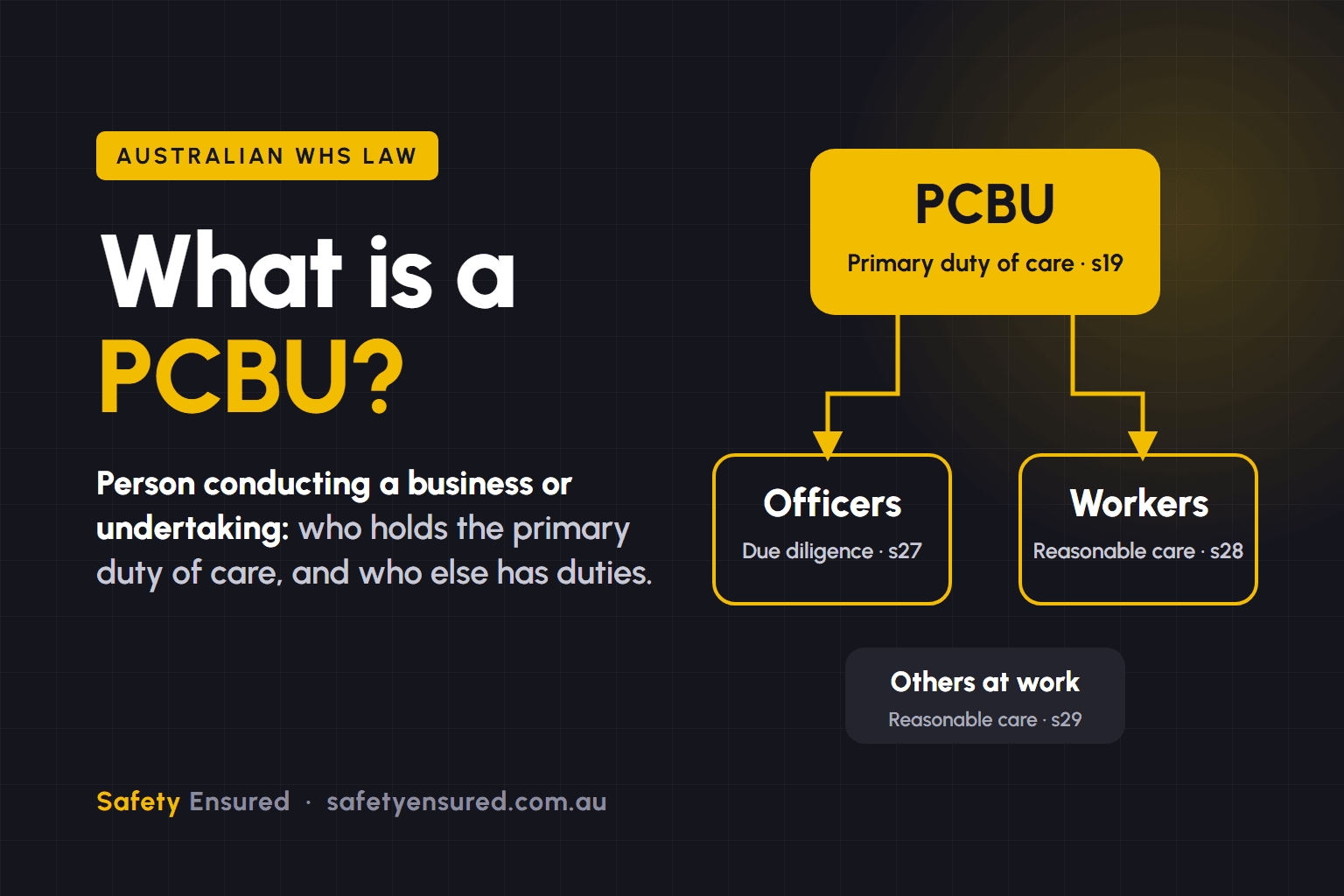
- PCBU: the business or undertaking itself. It holds the primary duty of care to ensure health and safety so far as is reasonably practicable.
- Officer: a person who makes, or participates in making, decisions that affect the whole or a substantial part of the business, such as a director, company secretary, partner or senior executive. Officers must exercise due diligence to ensure the PCBU complies with its duties (section 27).
- Worker: anyone who carries out work for a PCBU, including employees, contractors, labour hire workers, apprentices and volunteers. Workers must take reasonable care for their own and others' health and safety and follow reasonable instructions (section 28).
- Other people at the workplace: visitors and customers must also take reasonable care and comply with reasonable instructions (section 29).
A sole trader, for example, is the PCBU and a worker at the same time. A director of a family company may be both an officer and a worker.
Are you an officer of a PCBU?


What happens if a PCBU fails its duties?
The WHS Act sets out three categories of offence, from failing to comply with a duty (Category 3), to failing a duty in a way that exposes someone to a risk of death or serious injury or illness (Category 2), to reckless conduct (Category 1). The maximum penalties for corporations run into millions of dollars, and individuals can face large fines and, for Category 1 offences, imprisonment. Most jurisdictions have also introduced industrial manslaughter offences for the most serious failures.
Regulators can also issue improvement and prohibition notices, accept enforceable undertakings, and publish the outcomes of prosecutions.
Key takeaways
- PCBU means person conducting a business or undertaking. It covers companies, sole traders, partnerships, not-for-profits and government, whether or not they make a profit.
- The PCBU holds the primary duty of care for workers and anyone else affected by its work.
- Duties are qualified by what is reasonably practicable, and cost only rules out a control when it is grossly disproportionate to the risk.
- Where several PCBUs are involved, each keeps its own duty and must consult, cooperate and coordinate with the others.
- Officers have a separate, personal duty of due diligence, so directors and senior managers can't rely on the business alone.
This article is general information about the model WHS laws, not legal advice. Duties and penalties vary slightly between jurisdictions, so check your state or territory's WHS Act and regulator for specifics.