Table of Contents
Officer due diligence under the WHS Act: the six duties explained
What section 27 of the WHS Act requires of directors, partners and senior managers, and how to show you've met it
Most people know that a business has to keep its workers safe. Fewer realise that the people running the business have their own, personal WHS duty. Under the model WHS laws, every officer must exercise due diligence to make sure the business meets its safety obligations, and an officer who doesn't can be prosecuted personally.
This guide explains who counts as an officer, the six elements of due diligence in section 27 of the WHS Act, what each looks like in practice, and the records that show you've met them.
What is officer due diligence?
A person conducting a business or undertaking (PCBU) has the primary duty of care for its workers and others affected by its work. Section 27 of the WHS Act adds a separate duty for the PCBU's officers: they must exercise due diligence to ensure the PCBU complies with its duties and obligations.
Three features make this duty different from most legal obligations:
- It is personal. The duty sits with each officer as an individual. It can't be delegated to a safety manager or consultant, although officers can rely on their advice when that reliance is reasonable.
- It is proactive. Officers need to take positive steps before anything goes wrong. Reacting well after an incident isn't enough.
- It stands on its own. An officer can be prosecuted for failing due diligence whether or not the PCBU itself has been prosecuted or convicted.
Who is an officer?
The WHS Act borrows its definition of an officer from the Corporations Act. In practice, officers include:
- company directors and company secretaries
- other people who make, or participate in making, decisions that affect the whole or a substantial part of the business, such as a CEO, CFO or general manager
- people with the capacity to significantly affect the business's financial standing
- partners in a partnership, and officers of unincorporated associations and other bodies
- certain senior public servants in government agencies
Seniority alone doesn't make someone an officer. A site manager who carries out decisions made by others usually isn't one, while a general manager who sets budgets and priorities across the business usually is. Elected members of local councils and ministers acting in those roles are not officers.
Volunteer officers, such as unpaid committee members of a not-for-profit, still have the due diligence duty, but they can't be prosecuted for failing it.
The six elements of due diligence
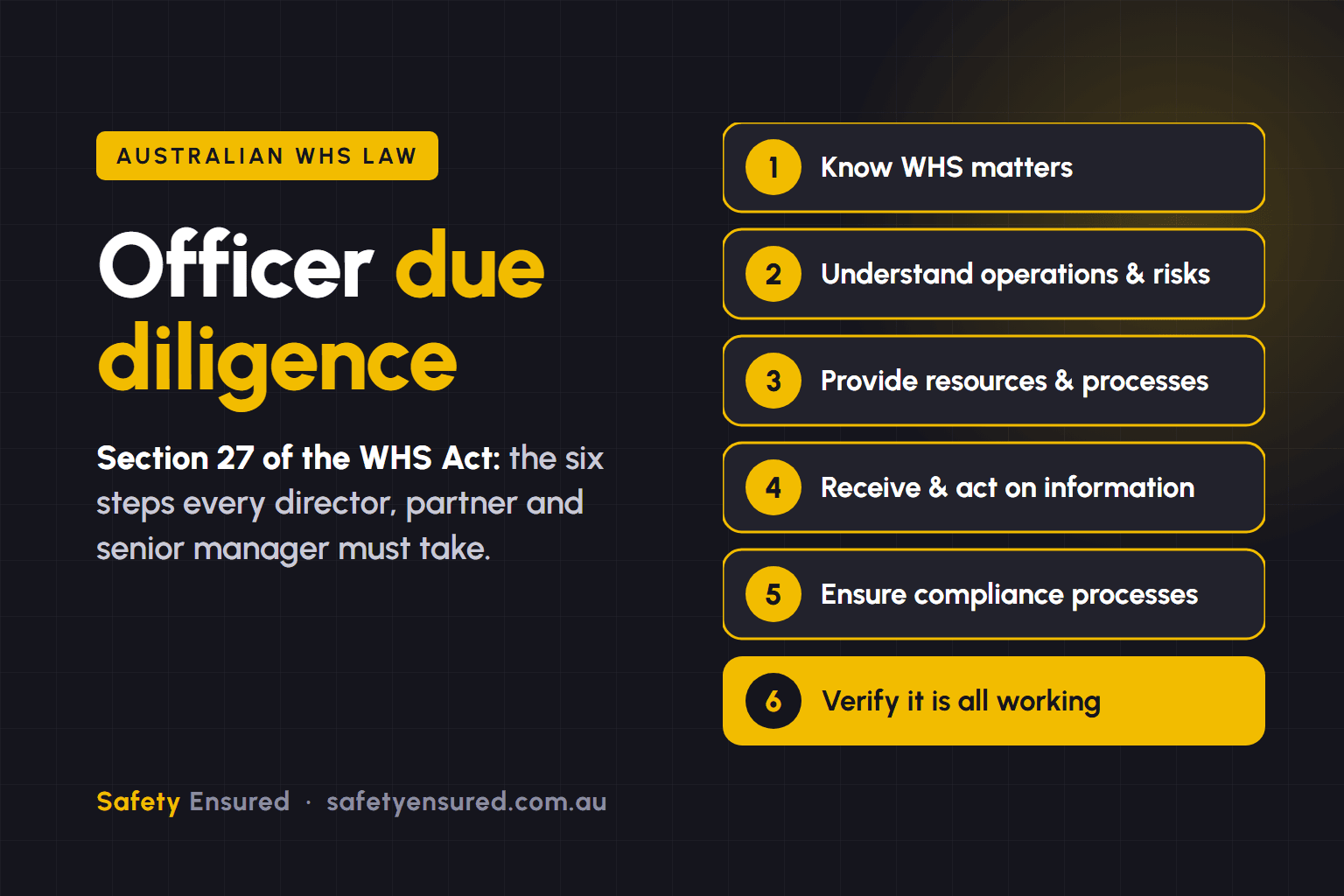
Section 27(5) of the WHS Act lists six steps that due diligence includes. They are a minimum, not a complete list. For each one, here is what it typically looks like in practice.
1. Know about work health and safety
The duty: acquire, and keep up to date, knowledge of work health and safety matters.
Officers don't need to be safety experts, but they need enough knowledge to ask good questions and judge the answers. That means understanding the main WHS duties, how risk management works, and changes such as the regulations on psychosocial hazards. Practical steps include formal training, regular briefings from WHS advisers, and reading regulator guidance relevant to your industry.
2. Understand the operations and their hazards
The duty: gain an understanding of the nature of the business's operations and the hazards and risks associated with them.
Officers should know what the business actually does, where the serious risks are, and which ones could kill or seriously injure someone. Site visits, talking to workers and supervisors, and reviewing a register of critical risks all help. An officer who only ever sees the business through board papers will struggle to meet this element.
3. Provide resources and processes
The duty: ensure the business has, and uses, appropriate resources and processes to eliminate or minimise risks.
This is where decisions about money, people and time come in. Is there a realistic WHS budget? Are there competent people to manage safety? Do workers have the time, equipment and training to work safely? Officers should be able to show that when a risk needed resources, the business provided them, or that the decision not to was reasonable.
4. Receive and act on information
The duty: ensure the business has appropriate processes for receiving and considering information about incidents, hazards and risks, and for responding to that information in a timely way.
Officers need reliable information flowing up to them, and evidence that it leads to action. Good reporting combines lag indicators, such as injuries and incidents, with lead indicators, such as inspections completed, hazards closed out and training up to date. Clear thresholds for what must be escalated, and how quickly, turn reporting into control. Our article on translating WHS risk appetite into auditable governance actions covers how to set those thresholds.
5. Ensure compliance processes are in place
The duty: ensure the business has, and implements, processes for complying with its duties and obligations under the WHS Act.
These are the processes the law specifically requires, such as consulting workers, reporting notifiable incidents to the regulator, providing training, supervision and information, and complying with any notices. A register of the legal requirements that apply to the business is a useful way to check nothing has been missed.
6. Verify that it's all working
The duty: verify the provision and use of the resources and processes in elements 3 to 5.
Verification is the element most often missed. Policies and procedures on paper prove little; officers need evidence that they are used. That can come from internal and external audits, site observations, checking that corrective actions from incidents were completed, and asking to see records rather than accepting assurances.
Turn the six duties into practice


How to show you've exercised due diligence
If a regulator investigates, officers will be asked what they knew and what they did. Records answer those questions. Useful evidence includes:
- board and management meeting minutes that show WHS was discussed, questions were asked and decisions were made
- WHS reports to officers, with the actions taken in response
- training records for officers, as well as for workers
- notes from site visits and conversations with workers
- budget and resourcing decisions that addressed WHS risks
- audit reports, and evidence that their findings were acted on
Common due diligence mistakes
- Relying entirely on the safety manager. Officers can rely on expert advice, but they still need to understand it, question it and verify it.
- Watching only injury rates. A low injury rate can hide a serious risk that simply hasn't caused harm yet.
- Treating policies as proof. A policy shows intent. Due diligence needs evidence that the policy works in practice.
- No follow-up. Receiving a report or audit and not checking that its actions were completed undermines elements 4 and 6.
- Assuming a small business is exempt. The duty applies to officers of businesses of every size, including partnerships and family companies.
Penalties for officers
An officer who fails to exercise due diligence can be prosecuted under the same three categories of offence that apply to other duty holders. Individuals face substantial fines, and imprisonment is possible for the most serious (Category 1) offences, which involve reckless conduct. Most jurisdictions have also introduced industrial manslaughter offences that can apply to officers whose conduct causes a death. The exact penalty amounts vary between jurisdictions and are indexed over time, so check your state or territory's WHS Act for current figures.
A quick due diligence checklist
If you are an officer, you should be able to answer yes to each of these questions:
- Have I had WHS training in the last two years, and do I keep up with changes to the law?
- Do I know the business's most serious risks, and have I seen how they are controlled on site?
- Is WHS adequately resourced, with competent people, budget and time?
- Do I receive regular WHS reports that include lead indicators, with clear rules for escalating serious issues?
- Does the business consult workers, report notifiable incidents and meet its other legal obligations?
- Have I seen evidence, such as audits or records, that these processes actually work?
- Do our meeting minutes record the WHS questions I asked and the decisions we made?
A “no” to any of these is a gap worth closing now, before a regulator or an incident finds it.
Key takeaways
- Officers have a personal duty to exercise due diligence so the business complies with its WHS obligations.
- Officers include directors, partners and senior decision-makers, not just anyone with a senior title.
- Section 27(5) lists six elements: knowledge, understanding operations, resources, information, compliance processes and verification.
- Verification and records are what turn good intentions into due diligence you can prove.
- Officers can be prosecuted personally, whether or not the business is.
This article is general information about the model WHS laws, not legal advice. Check your state or territory's WHS Act and regulator for the rules that apply to you.